This shot, Happy Landings, of a hummingbird, took approximately 40 shots to get one good one. For most of the snaps, the hummingbird was either out of the frame, the wings looked funny, or was at an angle that wasn't quite right. Luckily, I had the leisure to just stand in one place for a while, shooting when it seemed right, moving to another spot to do a few more, etc.
To set up the shot, I knew I wanted a fast shutter speed (1/500) to best capture him. Faster than this, I probably wouldn't have had enough light in this spot under the umbrella of tree leaves and I wouldn't have been able to "stop" him but still get a sense of motion in the wings. I wanted to blur the background, because the hummingbird was the main event, not the leaves behind him, so I used a large aperture (f 5.6). I let the camera choose the ISO, 3200 in this case. I used the maximum zoom on my lens of 200 mm and used a 1.4x teleconverter. I would have liked to have been closer, but I seemed to scare them away at closer distances.
I shot this at the Boyce-Thompson Arboretum, Superior, Arizona (about an hour northeast of Phoenix). It's part of the Arizona State Park System and the University of Arizona.
Want some hummingbird trivia? They are among the smallest of birds and the only ones that can fly backwards. Like bees they get nectar from flowers, but need to eat insects to get enough protein. They have the highest metabolism of all animals and their heart rate is 1250 beats per minute and their wings beat about 3,000 times per minute. Their nests are held together with spider silk and although most don't make it past the first year, they can live up to a decade.
Thursday, April 22, 2010
Patience is a Virtue

Friday, April 9, 2010
The oddest national park site I've ever been to...

Alien Landing?, originally uploaded by Cocoabiscuit.
Casa Grande National Monument* is what's left of the ruins of a Hohokam village from about the 14th century. It is rumored to be the largest prehistoric (our history at least) building in North America. "Discovered" by Spanish explorers in the late 17th century and again by American archeologists in the late 19th century. Graffiti from several centuries of adventurers is carved on its walls (and it is now illegal to add your signature). In 1932, someone decided that it needed a roof to protect it from the elements, despite having survived 7 centuries without one. The roof is termed a "Ramada" and was built by the Civilian Construction Corps. It sits on a one mile square parcel of land set aside by presidential decree in the town of Coolidge, Arizona. (The town of Casa Grande is some miles east.) The structure is visible from miles as you approach the town.
This shot was with a Nikon D70, converted for infrared, f16, 1/320 sec, 45 mm.
*National parks are by act of Congress, while national monuments are by presidential executive order.
Saturday, March 27, 2010
The Best Camera is the Camera that You Have

Sometimes you find something nice, but don't have your camera with you. Most people have a camera in your phone these days, but then what to do with it? If you have an iPhone, it's easier and there are a number of apps that can help you to process the photo to fix it up a bit before using it or posting it. In this photo, I used "The Best Camera" app which has quick "fixes" with filters with cool names such as "Paris" that I used with this photo, "Jewel", "Candy", etc. To get more typical photo processing tools such as cropping, color and exposure adjustments, etc. I use "Photogene". Contrary to the hundreds of dollars you'll spend on Photoshop, these apps are <$5.
This photo is of a palm tree in Orlando that I took. I'm attending a conference and took a lunch time stroll outside. My first thought was "I wish I had a camera, the light is so wonderful" and then luckily I remembered the iPhone in my pocket.
Sunday, March 21, 2010
A Beautiful Day in the Neighborhood

With unexpectedly good weather for the weekend after a punishing winter, it was time to head to Kelly Drive. I was thwarted in planning to go to the Art Museum grounds by a regatta, so decided to go with it and photograph it instead. It was challenging because the background was more typical of late winter, but the action was all spring/summer.
Settings: f11, 1/250 sec, 200mmSunday, March 14, 2010
The Value of Getting Close - Zooms and Teleconverters

Galapágos Tortoise originally uploaded by Cocoabiscuit. Using a zoom or walking close to the item being photographed really works out. The subject of interest is the tortoise, not the background, which was just a dirty enclosure filled with other very similar tortoises. By getting close, you get a much better picture of the textures and colors.
Because getting inside the pen with the tortoises was really discouraged by the folks at the Darwin Research Center (Santa Cruz Island, the Galapágos), I used 3 ways to get closer. The low tech way was to lean as far over the fence as possible. The rest was optical: a zoom lens, in this case a Nikkor 18-20 VR and then to get even closer a teleconverter. I bought a Kenko N-AF 1.4X teleconverter specifically for this trip. It snaps on between the regular lens and the body of the camera. It extends the maximum zoom of the regular lens (200mm) to 340mm. Caveats are that because it is essentially putting a magnifying glass in front of your camera body, it also magnifies light and I had to use exposure control of about 1.5 to compensate and the exif data for the camera won't reflect the increased zoom.
Wednesday, February 24, 2010
Diego, the Stud Muffin Tortoise
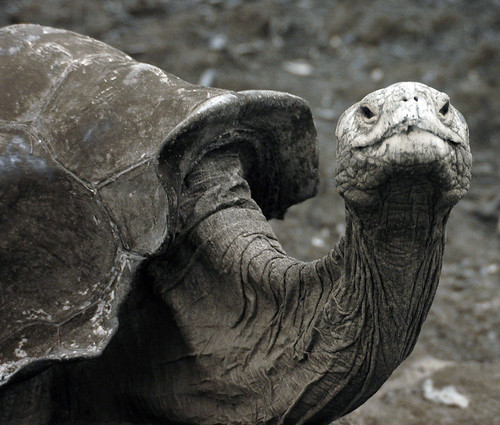
Diego is a Galapagos Tortoise at the Charles Darwin Research Center in Puerto Ayora on the island of Santa Cruz in the Galapagos, Ecuador. The Galapagos Tortoise is the world's largest tortoise and lives only on the Galapagos (and in zoos). Initially numbering over 200,000 when the islands were "discovered" by traders and pirates, they are now endangered and some of the sub-species are extinct. Sailors from passing ships would take the tortoises to use as food. Tortoises could survive for up to a year without food or water, so they were stacked in the hold of the ship to be used as needed for food. Another reason for the decline in their numbers is the introduction of non-native animals which steal and eat their eggs.
The Darwin center has a breeding program in an attempt to increase the success of turtles hatching from eggs. The baby turtles are then re-introduced to the islands where they belong. "Lonesome George" the most famous of the Galapagos tortoises, is the last of the tortoises from Pinto Island showed no inclination to reproduce. Diego was one of the 15 remaining tortoises from Espanola and was located at the San Diego zoo. He was brought in to service female tortoises-- and has single handedly contributed to ensuring that the Espanola tortoises will not become extinct.
This photo is an infrared photo taken with my IR converted Nikon D70, f 4.5, 1/125 sec, 105 mm. The lighting was challenging because it was early morning and foggy.
Thursday, February 18, 2010
Diabillos

In Ecuador, instead of mardi gras, they celebrate a hybrid of Catholic and Huarangas traditions. What results is a four day weekend celebration where families go to the beach and in small villages, children referred to a diabillos or little devils chase each other with water. In the original huarangas tradition, people throw water and flowers were tossed to show admiration, but the updated version is more about water balloons and shaving cream. Older teens drove to a nearby river and filled large tubs of water which they would then douse people with from the backs of pickup trucks.
I shot this photo from inside a car (with closed windows) in a small town, Cotacachi,as we drove by these two girls and the youngest one was trying to decide whether or not to spray us with shaving cream. Settings were f 6.0, 1/640 sec, 60 mm, ISO 400. Because I was shooting through a car window, I cleaned it up in Photoshop.