This photo, an infrared HDR shot of the Mississippi Monument in Gettysburg National Historic Battlefield Park blends a variety of techniques. First, it was shot with an infrared converted Nikon D70 so that they only light hitting the sensor is in the infrared spectrum. That gives the white grass and leaves and the enhanced darkness of the monument stone. The cottony quality of the sky reflects early morning with a combination of low sun and the fog not totally lifted.
The second technique is HDR with 3 shots taken: one overexposed to bring out the features in the statue and the house that was in the shade, one normally exposed, and one underexposed to bring out the texture in the sky. I used a tripod to keep all of the images aligned. combined the images in Photomatix, and did more work in Photoshop for the final effect. They were shot at f/16 with shutter speeds of 1/40, 1/80, and 1/160 respectively at an ISO of 400.
Wednesday, July 28, 2010
Blending Techniques

Monday, July 12, 2010
Add dimension, find an interesting angle...


When shooting during travel photography, there's a natural inclination to try to document what you have seen by lining up right in front of it and clicking the shutter. Voila, an image that anyone could have captured and one that is immediately recognizable to someone casually walking by. Ironically, though, by documenting you may not be informing. Try finding a more interesting angle, from above, below, obliquely, etc. In these two images, both of the same barn near Norwich, NY, the first one is a straight on shot, but the second, I think, is a more interesting angle and shows much more depth. Photographers have the option of going for a higher angle (use a ladder, climb a tree) or lower (lie on the ground). In this case, I was lucky and just walked down the small hill leading up to the barn. Remember, with any shot, you make choices about what to include and what to exclude (in this case, by choosing this angle, you lose the silo).
Both of these photos were shot with a Nikon D300, f11. 1/125 sec and 1/160 sec respectively, ASO 400 with a wide angle lens, 18 mm and 27 mm respectively. The images were then processed in Photomatix for an HDR effect. The bright sunlight and interesting clouds were luck.
Wednesday, June 9, 2010
If You Find Yourself in Nashville...
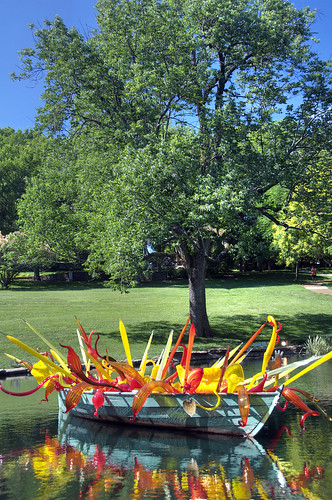
This summer at the Cheekwood Botanical Gardens in Nashville, Tennessee, the landscapes have been transformed with environmental art-- floating in the pond, erupting from the ground like plants, scattered along the landscape, replacing the water in fountains. The Gardens, even without the blown glass is beautiful, but the addition of Dale Chihuly's art really makes for a special trip. On Thursday and Friday nights, the glass is illuminated. "Chihuly at Cheekwood" is on display through the end of October. Visit Nashville if you can, they are really struggling after the recent flood.
Monday, May 31, 2010
Textures

When composing a photo, consider how different textures might add interest to the photo. In this photo, Seaside, taken in the pool area of the Gallows Point complex in Cruz Bay, St. John, US Virgin Islands, there are a variety of textures. There is the smoothness of the palms and the cotton candy sky, the shiny metal of the chairs, the backs of the chairs that are semi-transparent so that you can see yet another texture behind it, and the choppy texture of the water (both of the ocean beyond and of the small area of pool in the foreground).
This photo was taken with an infrared converted Nikon D70, mounted on a tripod to get the maximal depth of field, f 18 and a shutter speed of 1/80 sec. The image was then processed in Photomatix to givea high dynamic range (HDR) image to mimimize the differences in lighting in the various areas of the shot.
Monday, May 24, 2010
Swim With the Fishes
Swim with the Fishes, originally uploaded by Cocoabiscuit.
Somehow, still images just didn't capture the rhythm of this school of fish as they swam along the reef.
These photos were taken with an Olympus Tough, a point and shoot camera for up to 15 feet deep. I took a combination of still and video and unfortunately left the power cable home, so these will be the only pictures from this camera. Luckily I have a back up camera assuming there are no more equipment malfunctions (or packing malfunctions rather).
I'm still working on figuring out how to best take underwater pictures, so stay tuned.
Saturday, May 22, 2010
Worth the mosquito bites?
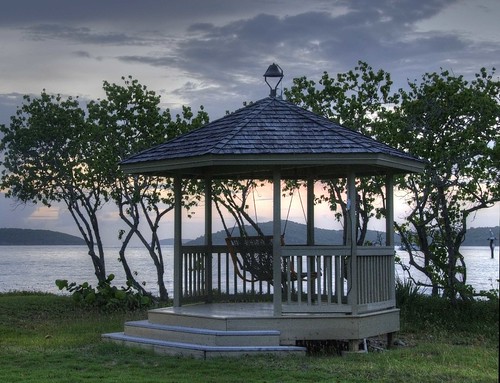
Often times there's a moment when the rest of the world fades away. This moment with the sun setting behind this gazebo was so ethereal that I unfortunately did not notice the swarm of mosquitos that had landed on my legs. Oh well, it was worth it.
This shot, Gallows Gazebo was taken at Gallows Point on St. John, US Virgin Islands. The view is looking over Cruz Bay at the British Virgin Islands.
I shot it on manual settings of 1/6 sec, f10, ISO 400 (on a tripod) with my Nikon D300. Then I processed it with a little bit of HDR in Photomatix to bring out the colors of the sunset but also still have some detail in the gazebo.
Thursday, April 22, 2010
Patience is a Virtue

This shot, Happy Landings, of a hummingbird, took approximately 40 shots to get one good one. For most of the snaps, the hummingbird was either out of the frame, the wings looked funny, or was at an angle that wasn't quite right. Luckily, I had the leisure to just stand in one place for a while, shooting when it seemed right, moving to another spot to do a few more, etc.
To set up the shot, I knew I wanted a fast shutter speed (1/500) to best capture him. Faster than this, I probably wouldn't have had enough light in this spot under the umbrella of tree leaves and I wouldn't have been able to "stop" him but still get a sense of motion in the wings. I wanted to blur the background, because the hummingbird was the main event, not the leaves behind him, so I used a large aperture (f 5.6). I let the camera choose the ISO, 3200 in this case. I used the maximum zoom on my lens of 200 mm and used a 1.4x teleconverter. I would have liked to have been closer, but I seemed to scare them away at closer distances.
I shot this at the Boyce-Thompson Arboretum, Superior, Arizona (about an hour northeast of Phoenix). It's part of the Arizona State Park System and the University of Arizona.
Want some hummingbird trivia? They are among the smallest of birds and the only ones that can fly backwards. Like bees they get nectar from flowers, but need to eat insects to get enough protein. They have the highest metabolism of all animals and their heart rate is 1250 beats per minute and their wings beat about 3,000 times per minute. Their nests are held together with spider silk and although most don't make it past the first year, they can live up to a decade.